
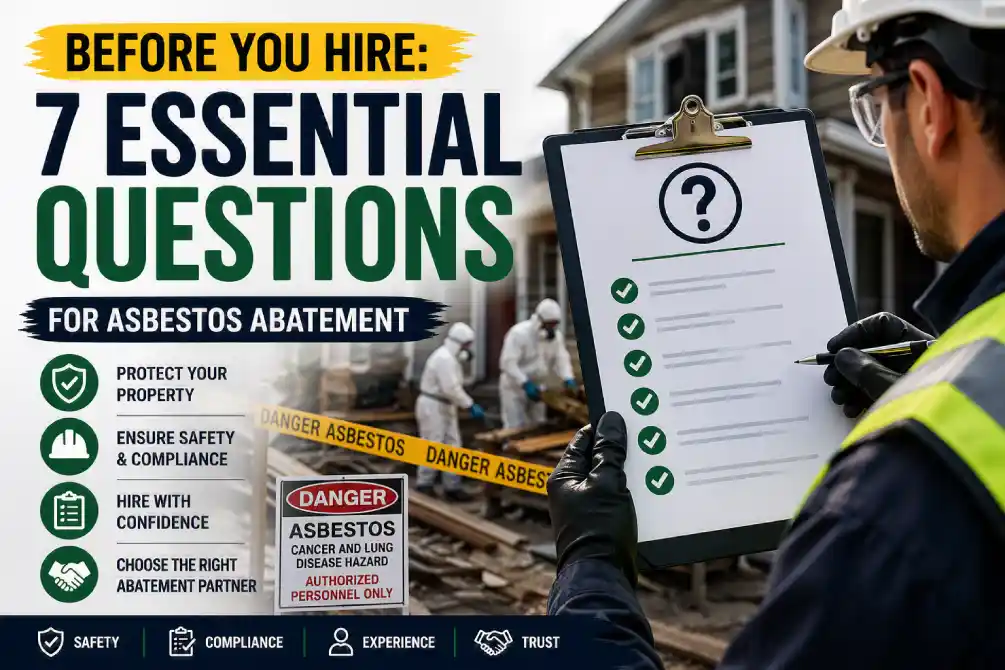
Hiring an asbestos abatement contractor isn’t like hiring a painter or a carpenter. Get it wrong, and you’re not just looking at a bad paint job — you could be left with airborne fibres throughout your home, a stalled renovation, and legal liability if the work wasn’t done to code.
The good news: BC’s licensing system makes vetting a contractor far more straightforward than it used to be. Use the seven questions below during your initial conversation with any contractor — a licensed, reputable company will answer all of them clearly and without hesitation.
1. What is your WorkSafeBC Asbestos Abatement License (AAL) number?
As of January 1, 2024, it’s illegal to perform asbestos abatement work in BC without a valid AAL. Every contractor listed on this site includes their AAL number, but don’t just take a number at face value — cross-check it yourself against WorkSafeBC’s public AAL Registry to confirm it’s current and in good standing before any work begins.
2. Are the workers on-site Level 2 or Level 3 certified?
A company can hold a valid AAL while still having uncertified individuals show up to do the work — which is why this question matters on its own. Level 2 certification is required for anyone performing abatement work directly; Level 3 is for supervisors overseeing the site. Ask to see WorkSafeBC certification cards for the actual crew arriving at your property, not just proof of the company’s licence.
3. Will a third-party company handle air monitoring and clearance testing?
For moderate- and high-risk projects, it’s a genuine conflict of interest for the same company doing the removal to also test and sign off on their own air quality results. A reputable contractor will recommend an independent lab for final air clearance testing rather than handling it in-house. If a contractor insists on doing both with no independent check, ask why.
4. Can you provide a current WorkSafeBC Clearance Letter?
This is a different document from the air clearance testing above — a WorkSafeBC Clearance Letter confirms the company’s account is active and in good standing, meaning they’re up to date on insurance premiums and payroll reporting with WorkSafeBC. It protects you from being held liable for a contractor’s unpaid premiums if something goes wrong. Ask for a current letter addressed to you before work begins.
5. Will you file a Notice of Project (NOP) with WorkSafeBC?
For most asbestos abatement work, contractors are legally required to submit a Notice of Project to WorkSafeBC at least 48 hours before work begins. This isn’t optional paperwork — it’s how WorkSafeBC tracks and, where needed, inspects abatement work across the province. A contractor unwilling to confirm they’re filing an NOP is a serious red flag.
6. How do you handle waste disposal, and will I receive a Waste Manifest?
Asbestos waste can’t go in the regular trash. In BC, transporting more than 5 kg of asbestos waste legally requires a transport licence and a Waste Manifest — your proof that the material was properly dropped off at an authorized disposal facility. Ask your contractor to confirm disposal is included in your quote and that you’ll receive manifest documentation once the job is complete.
7. What’s your plan for containment and HEPA filtration?
A qualified contractor should walk you through their containment process without prompting: sealing the work area with poly sheeting, and running negative-air HEPA filtration machines to keep fibres from spreading to the rest of the building. If the answer is vague or dismissive, that’s worth pausing on — this is the part of the job that protects the rest of your home during the work.
Ready to find a licensed contractor?
Every contractor listed on this directory is cross-checked against the WorkSafeBC AAL Registry and organized by BC region, so you can compare licensed, verified options near you without starting from scratch. Browse contractors in your region or request a quote to get started.
Browse Licensed Asbestos Contractors by BC Service Area
Select your region below to view contractors, service areas, and local asbestos removal information.
📍 VANCOUVER ISLAND📍
Victoria ▪️ Nanaimo ▪️ Duncan
📍LOWER MAINLAND & SOUTHWEST📍
Vancouver ▪️ Surrey ▪️ Richmond
📍THOMPSON & OKANAGAN📍
Kamloops ▪️ Kelowna ▪️ Vernon
📍KOOTENAY AREA📍
Cranbrook ▪️ Nelson ▪️ Trail
📍CARIBOO DISTRICT📍
Quesnel ▪️ Williams Lake
📍NORTHERN BC📍
Prince George ▪️ Terrace ▪️ Fort St John